Challenge C – BC Student Mental Health Resource Guide
An Open Educational Resource
Updated: November 20th, 2025
Author: Emma Lee
I am creating this mental health resource page to compile helpful and reliable resources for those in need of mental health support. I thought it was important to share these and let individuals know that it is okay to seek help. I chose this topic because the conversation around mental health is becoming more talked-about and normalized and I think it is extremely important to keep the conversation going in a positive light. The goal for this project is to help educate individuals about mental health and provide ways of support if they need them in the form of phone numbers connecting with emotional support or hotlines, websites for chat-based support and information as well as tips for self-care to maintain mental health and well-being.
Link to the website: https://emmalee5656.wixsite.com/mentalhealth
Understand (Discover, Interpret, Specify)
Describe the Challenge
Post-secondary students in British Columbia need to be aware of mental health resources to effectively manage academic stress and maintain overall well-being.
Context and Audience
My target audience includes post-secondary students who reside in British Columbia who are navigating the demands of school while managing their mental health. Post-secondary students often experience high levels of stress due to their classes, along with other potential stressors such as financial pressure and juggling a job, relationships, moving out or away from home and day-to-day responsibilities. This leaves them with limited time or energy to prioritize mental health and seek out support if needed. They may not know where to start or which resources are reliable, as well as may not think they have the financial support to afford resources. The motivations and goals of my target audience is to feel supported, informed and empowered in caring for their mental health as an essential part of maintaining their overall well-being and a healthy lifestyle.
This mental health resource guide can be used by anybody in British Columbia as many of the resources are free, online services and some are even available throughout all of Canada. However, many individuals may find some resources less helpful as a lot of the content is specifically directed towards post-secondary students, such as the resources on various university and college campuses. The resources being free help make it more accessible to a greater variety of individuals, though they would still require a device, internet, and/or a phone to connect with many of the hotlines.
Younger individuals such as adolescents may also find part of this resource useful as though they won’t be able to access the campus-based resources, they will likely have an easier time using the online or app based support methods. These may be a good option for them, especially in the scenarios where their parents/families are not super supportive about mental health or comfortable talking about it. Having free, online options allow adolescents to take the initiative into getting support and learn more about how to improve their mental health in a safe environment.
Older individuals may also find parts of this open educational resource helpful as many private practices and counselling services are expensive, so this offers them a free alternative. Using online resources may also be helpful with their busy schedules and day-to-day lives, especially if they have children, and/or a demanding job. These options require less commitment, no cost and no travel time.
POV Statement
A post-secondary student in British Columbia needs easily accessible and trustworthy mental health resources to manage their well-being, cope with academic pressures, and feel supported both on and off campus.
Learning Objectives
By using this guide, students will be able to:
- Recognize common mental health challenges or signs of distress among students
- Help to normalize conversations about mental health and reduce stigma
- Identify and evaluate credible, accessible mental health resources available in BC (including campus supports, helplines, crisis support, and online services).
- Build confidence in reaching out for help when needed
- Practice self-care and coping strategies that promote emotional regulation and well-being
- Create healthy routines for daily student life
- Support peers who may be struggling and connect them to the appropriate support system
- Reflect on personal health and wellness
Plan (Ideate, Sketch, Elaborate)
Ideation
I decided to stick with what I know and keep to my psychology theme for Challenge C. I wanted to do something mental health related and create an Open Educational Resource that was useful. I came up with the idea to do a mental health resource guide for BC post-secondary students to make it easier to find help, and encourage them to do so if needed. When students are looking for mental health resources, it can often be overwhelming and I wanted to give them a good place to start their search.
My most promising prototype was creating a site on Wix that had information regarding what mental health is, where to get help and tips on general self-care.
Storyboard or Script
Home Page: BC Student Mental Health Resource Guide
- Mission statement: This Open Mental Health Resource page is an accessible, educational platform created to support post-secondary students in British Columbia by connecting them to reliable mental health resources and information, encouraging self-care, and helping them maintain a healthy, balanced lifestyle.
- Disclaimer: This resource is for informational and educational purposes only and is not a substitute for professional mental health care, diagnosis, or treatment. If you are experiencing a mental health crisis or need immediate support, please contact local emergency services or a qualified mental health professional.
Crisis and Immediate Help Page
If you or somebody you know is in crisis, please reach out right away
Crisis lines:
- 988 National Suicide Crisis Helpline
- Available in English or French to call or text for anybody in Canada
- 1-800-SUICIDE (1-800-784-2433) Crisis Intervention and Suicide Prevention Centre of BC
- Available by phone in up to 140 languages for anybody in British Columbia
- 1-800-588-8717 BC KUU-US Indigenous Crisis and Support Line
- Available by phone for Indigenous individuals in British Columbia
- 310-6789 (no area code) BC Crisis Line
- Available by phone for anybody in British Columbia
- 604-872-3311 Vancouver Coastal Regional Distress Line
- Available by phone for residents in the Vancouver Coastal region
- 1-800-668-6868 Kids Help Phone
- Available by phone, text, and online for young people across Canada including children, teens, and young adults
- 1-833-Metis-BC (1-833-638-4722) Métis Crisis Line
- Available by phone for Métis individuals in British Columbia
These services are all confidential, free, and available 24/7.
In an emergency situation, please do not hesitate to visit your nearest emergency centre or call 911.
24/7 Immediate Support Lines
- The services below offer immediate emotional support, even if you’re not in crisis.
- Here2Talk
- Canada-wide toll free, dial: 1-877-857-3397
- Canada-wide direct, dial: 604-642-5212
- Available for registered post-secondary students in British Columbia online, on the app or by phone
- TELUS Health Student Support
- 1-844-451-9700
- Available online, on the app or by the phone for students who attend post-secondary institutions that have partnered with TELUS Health (availability varies by campus)
- Hope for Wellness Helpline
- 1-855-242-3310
- Available online or by phone 24/7 to all Indigenous people across Canada
- Trans Lifeline
- 1-877-330-6366
- Peer-run hotline for trans and nonbinary people across Canada
- Here2Talk
Self Care Page
Self-Care involves listening to your needs and taking small, intentional steps to support your mental, emotional, and physical health and well-being.
Everyday Tips:
- Meditation
- Try this: Set a timer for 2 minutes, close your eyes and focus on your breathing.
- Journaling
- Try this: Take 5 minutes tonight to write down 3 things you are grateful for or things that went well today.
- Practicing mindfulness
- Try this: Set a timer for 2 minutes and try box breathing: inhaling through the nose for 4 seconds, hold for 4, then exhaling through the mouth for 4 seconds.
- Exercise
- Try this: Take 10 minutes today to walk, stretch, or do a quick set of exercises. How does your energy and mood feel after?
- Spend time in nature
- Try this: Take a short walk on campus without headphones. What sounds, colours and smells do you notice?
- Connect with others
- Reach out to a friend or family member and send a quick check-in message. How do you feel after connecting?
- Sleep routine
- Try this: Turn off screens 30 minutes to 1 hour before bed and do a relaxing activity such as reading. Reflect on the quality of your sleep in the morning.
Reflection Prompts:
Self-care looks different for everybody. Try using some of the prompts below to reflect on what supports your well-being.
- How does connecting with others impact your mental health?
- What self-care habit makes you feel the most grounded?
- What is one self-care tip you want to try today?
- What patterns do you notice in your stress, mood, and/or energy levels throughout the week?
- What signs tell you that you’re starting to feel overwhelmed?
- What environments (quiet, nature, music, social spaces, etc.) help you feel the best?
- What boundaries do you set to protect your mental and emotional well-being?
- What activities make you feel calm or recharged?
- What is one small thing you can do this week to take care of your future self?
Self-Care Checklist
- I took 2-5 minutes to focus on my breathing today.
- I took a short walk to take a break from screens and get fresh air.
- I put my phone away at least 30 minutes before sleeping.
- I reached out for support when I needed it.
- I took a break when I felt overwhelmed.
- I practiced one mindfulness exercise today.
- I set a small boundary (said no, slowed down, etc.).
- I noticed one thing that stressed me out today and one thing that helped.
- I drank about 8 cups of water today.
- I practiced being kind to myself today.
Self-Care involves listening to your needs and taking small, intentional steps to support your emotional and physical well-being.
Looking for support beyond self-care? Visit our Support & Resources page
Support & Resources Page
Free Online Resources:
- Here to Help BC
- Provides mental health and substance use information, self-help tools, and BC-specific support options
- BounceBack
- Free online videos and workbooks designed to help manage low mood, stress and anxiety
- Centre for Clinical Interventions
- A self-help website that offers workbooks and information sheets for managing mental health challenges like anxiety, depression, procrastination, and more
- Be There (Jack.org)
- A guide on how to recognize when someone is struggling and how to support them in a safe and respectful manner
- Foundry BC
- Provides information for youth and young adults on mental health, well-being, substance use, relationships and self-care
Free Mental Health Apps:
- Calm Harm
- Provides techniques to help resist or manage urges to self-harm using distraction, grounding exercises and coping strategies
- Smiling Mind
- A mindfulness and meditation app created to help reduce stress and improve emotional well-being
- Headspace
- A meditation and wellness app that has guided meditations, sleep support, and stress-reduction practices
- Calm
- A meditation and sleep app with guided breathing exercises, music, and relaxation tools to support stress and anxiety management
- Joypop
- Helps users manage stress by tracking moods, journaling, breathing exercises and grounding activities
These apps are all available on iOS and Android.
Campus-Based Resources
Each post-secondary institution has its own mental health and wellness support. The examples below highlight a few key campuses. Check your own school’s student wellness or counselling page for specific programs and services.
University of Victoria
- UVSS Peer Support Centre
- Open for drop-in support provided by trained volunteers.
- Hours: Monday to Friday, 11am to 3pm
- Student Wellness Centre
- Offers counselling, health services, workshops, and wellness programs.
- Hours: Mon, Tues, Thurs & Fri: 8:30am to 4:30pm. (closed noon to 1pm). Wed: 10am to 4:30 pm (closed noon to 1pm). Hours may vary by semester. Check the UVic website for current availability.
- SupportConnect
- Free, confidential mental health support service for registered students.
- Available 24/7 by phone, video counselling, and online text/chat.
University of British Columbia
- AMS Peer Support
- Peer-led, confidential support for students.
- Hours: Open Monday-Friday from 10am to 5pm.
- UBC Student Recovery Community (SRC) for addiction recovery
- Safe, confidential peer community and support for students affected by addiction with substances and/or non-substance addictive behaviours or are in recovery. Meetings are typically held in-person and online.
- Hours: Monday to Friday, 11:00 am to 4:00 pm. Hours and events vary. Check the SRC for updated availability.
- Counselling Services at UBC
- Counselling, group programs, and mental health workshops. Appointments are offered in-person, virtually, or over the phone.
- Hours: Weekdays from 8:30am to 4:30pm.
Simon Fraser University
- SFU Health & Counselling Services
- SFU students can receive free confidential support through individual sessions, group activities and self-guided resources.
- Counselling appointments are offered in-person, online or by phone.
- Hours: Hours differ by clinic location.
Douglas College
- Douglas Counselling Service
- Free, confidential one-on-one and group counselling sessions (in-person or virtual) for registered students. Counselling services offered in-person and online.
- Hours: Monday, Tuesday, Thursday, Friday 8:30am to 4:30pm. Wednesday 10:00am to 4:30pm. Hours may defer by campus.
Camosun College
- Camosun Counselling Centre
- Short-term, confidential counseling for registered students, available by phone, video, or in person.
- Hours: Monday, Wednesday, Friday: 9am to 4pm. Tuesday: 10:30am to 6pm. Hours may vary each term.
These are only a few examples of mental health support and resources offered at BC post-secondary institutions. Most campuses provide free or low-cost counselling, peer programs, and wellness workshops. Many also offer free online services for their students, making getting support more easily accessible. Check your school’s website for local resources.
Learn about Mental Health Page
What is Mental Health?
Mental health refers to our emotional, psychological, and social well-being. It impacts how we think, feel, and act. It also influences how we handle stress, build relationships, and make decisions.
Why Does Mental Health Matter?
Mental health impacts every part of our day-to-day lives, including academic performance, relationships, motivation, and physical health. When mental well-being is properly supported, students are able to learn, focus, and manage stress better, as well as engage fully in school and daily life.
Common Mental Health Challenges for Post-Secondary Students
Many students experience increased stress from academic pressure, financial strain, major life transitions and changes, and/or living away from home.
Common challenges include:
- Anxiety
- Depression
- Burnout
- Feelings of loneliness or social isolation
- Sleep problems
- Difficulty managing time and balancing responsibilities
- Relationship stress
Signs That it Might be Time to Reach-Out
It may be helpful to seek support if you’re feeling overwhelmed for an extended period of time, experiencing persistent sadness or anxiety, withdrawing from friends, struggling academically, having trouble sleeping or eating, or noticing changes in mood that impact your daily functioning. Researching out for support early can make a big difference.
How to Support a Peer
Supporting a friend or classmate who may be struggling with their mental health can make a huge difference. Small, compassionate actions can help them feel seen and less alone.
Tips to help a peer:
- Listen to them without trying to solve everything
- Validate their feelings
- Respect boundaries
- Check-in
- Gently encourage professional or campus support if needed
- Know when to seek immediate help
- Be kind, empathetic and understanding
- Listen actively and openly
- Be patient
- Offer reassurance
About Page
About this resource
This Open Mental Health Resource was created to support post-secondary students in British Columbia by providing clear, accessible information about mental health. It outlines reliable tips, tools, and local resources to help students understand mental health, recognize when they, or their peers may need support, and explore options for care.
Open License
Content on the BC Student Mental Health Resource Guide is licensed under a Creative Commons Attribution 4.0 International License (CC BY 4.0). This means you are welcome to reuse, share, and adapt, and redistribute the material for any purpose, as long as credit is given to the creator.
This open license helps make mental health information and resources more accessible to students and encourages sharing and collaboration across British Columbia.
Download and Adapt
To support open sharing, editable versions of this resource are available below:
- Crisis and Immediate Help Resources
- Everyday Tips and Reflection Prompts
- Self-Care Checklist
- Online Resources and Apps
- Campus-Based Resources
- Learn About Mental Health
- How to Support a Peer
Anyone is welcome to download, modify, and redistribute these materials.
Principles Applied
I followed the ICAP Framework in my open educational resource as I had a mixture of passive learning and active learning, while allowing users to demonstrate and apply their knowledge. To incorporate active learning and make the open educational resource more interactive, I added “try this” prompts under the everyday tips on the self-care page, along with reflection prompts and an interactive self-care checklist that users can use to track their daily self-care activities. The personalization principle was used and is seen in the conversational, empathetic language that is used. I also used the signaling principle as I added headings and subheadings to each page to help keep the site organized and emphasize key information. To incorporate principles from the Universal Design for Learning (UDL) I added alt text to my images and icons, as well as using an easy to read font and descriptive links.
Create and Share the Prototype
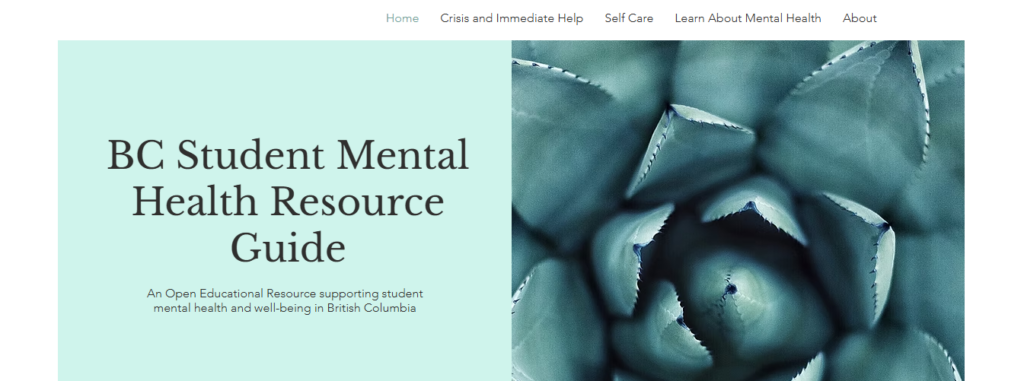
Preview of the home page made on Wix
Home Page: BC Student Mental Health Resource Guide
- An Open Educational Resource supporting student mental health and well-being in British Columbia
- Mission statement: This Open Mental Health Resource page is an accessible, educational platform created to support post-secondary students in British Columbia by connecting them to reliable mental health resources and information, encouraging self-care, and helping them maintain a healthy, balanced lifestyle.
Crisis and Immediate Help Page
If you or somebody you know is in crisis, please reach out right away
Crisis lines:
- 988 Suicide Crisis Helpline. Available in English or French to call or text.
- 1-800-SUICIDE (1-800-784-2433) Crisis Intervention and Suicide Prevention Centre of BC. Available in up to 140 languages.
- 1-800-588-8717 BC KUU-US Indigenous Crisis and Support Line.
- 310-6789 (no area code) BC Crisis Line.
- These services are all confidential, free, and available 24/7.
In an emergency situation, please do not hesitate to visit your nearest emergency centre or call 911
Self Care Page
Everyday tips for self-care:
- Meditation
- Try this: Set a timer for 2 minutes, close your eyes and focus on your breathing.
- Journaling
- Try this: Take 5 minutes tonight to write down 3 things you are grateful for or things that went well today.
- Practicing mindfulness
- Exercise
- Spend time in nature
- Try this: Take a short walk on campus without headphones. What sounds, colours and smells do you notice?
- Connect with others
Free Online Resources/Apps:
Campus-Based Resources
Each post-secondary institution has its own mental health and wellness support. The examples below highlight a few key campuses. Check your own school’s student wellness or counselling page for specific programs and services.
University of Victoria
University of British Columbia
- AMS Peer Support
- UBC Student Recovery Community (SRC) for addiction recovery
- Counselling Services at UBC
Simon Fraser University
Douglas College
Camosun College
These are only a few examples of mental health support and resources offered at BC post-secondary institutions. Most campuses provide free or low-cost counselling, peer programs, and wellness workshops. Many also offer free online services for their students, making getting support more easily accessible. Check your school’s website for local resources.
Learn about Mental Health Page
What is Mental Health?
- Add information on what it is, why it matters, common mental health challenges in students, and signs that it might be time to reach out
About Page
About this resource
- Talk about the page and the motivation behind it
Open License
Content on the BC Student Mental Health Resource Guide is licensed under a Creative Commons Attribution 4.0 International License (CC BY 4.0). This means you are welcome to reuse, share, and adapt, and redistribute the material for any purpose, as long as credit is given to the creator.
This open license helps make mental health information and resources more accessible to students and encourages sharing and collaboration across British Columbia.
Download and Adapt
To support open sharing, editable versions of this resource are available below:
- List these
Anyone is welcome to download, modify and redistribute these materials
Peer Feedback
A point of feedback I received was to improve the visual design by adding icons or visuals to illustrate the different sections of the open educational resource in order to apply dual coding and emphasize key ideas. To incorporate models of active learning in the resource, it was also suggested that I add interactive elements to allow users to engage with the content in a variety of ways. For smoother navigation, it was suggested that I add a fixed menu or quick links at the top of each page of the site, which would also reduce scrolling. Another suggestion I received was to add short descriptions for the linked resources to help users understand more about them and add authenticity and trust in the material.
From my second peer reviewer, the feedback I received included adding a small section on how to support a peer to help more directly fulfill my learning objective of supporting peers who may be struggling to the “learn about mental health page”. They also said that the organization could be a little clearer, including having one main “find help” page and then have sub-headings for each category such as “crisis lines”, “campus support” and “online apps”. Another suggestion was to add a brief disclaimer on the site stating that this is for informational purposes only and does not replace professional treatment. Adding specific resources for other groups like international students, LGBTQ2S+ students, and students with disabilities was also suggested.
Reflect and Refine
Reflection
I think that using Wix worked well and was a mostly smooth process. I had used it in the past but had to learn how to use new features on the site. I feel as though I would try to narrow down my topic more next time as there was a lot of content I wanted to cover, as well as a lot of content that I thought was necessary to have on the resource, but it was a lot of work, especially as I did the project by myself. With this type of resource, I could have kept adding more and more information on it and it was difficult for me to find a solid stopping point for the final product.
In my final project, I added a disclaimer to the site as suggested to let people know that this is not a substitution for professional support. From the peer feedback, I also organized my pages better so that the headings and sub-headings were more descriptive and made more sense. I took the suggestions to add a clearer section on how to support peers to connect back to my learning objectives and added some images and icons throughout the site to connect to the dual coding theory (Loveless, 2023). I also took the suggestion to add a short description to each resource so the user was able to better understand what they are about, how to access them, and choose the best resource for them. I made the menu bar at the top into a fixed bar for easier access to the other pages as suggested as well. I added a couple resources specifically for LGBTQ2S+ individuals as my peer suggested, but was not able to find resources specifically for students with disabilities or international students.
An issue I came across was not knowing how to add visuals, and which visuals to add, in order to balance the text in the site and decrease cognitive load (Granchelli, 2025). I also needed to narrow down the specific post-secondary institutions that I wanted to highlight on my open educational resource, as there are a lot in BC, and covering all of them would have been extremely hard and time-consuming. Choosing which ones to talk about took a lot of time and research as well though and eventually I settled on more of the well-known and bigger universities and colleges. While I wouldn’t really consider it an issue, a challenge I came across with was choosing the online apps and resources to add to the site as well. I had to make sure they were trust-worthy, reliable sites and resources that had credible information and were accessible. Many of the resources that I added to the site were found on government and post-secondary institution websites.
Strengths of this type of multimedia learning is that it is accessible, allowing users to explore information at their own pace. It also encourages active learning by allowing users to modify and create content which supports deeper engagement as described in the ICAP framework (Granchelli, 2025). It can be easily updated so there is up to date content and information available to users, which is especially important in terms of mental health resources. Another strength of this type of multimedia learning is that creators can incorporate many principles of the Universal Design for Learning (UDL) in their design process by using techniques like adding alt text, captions and descriptions for videos, and not using colour as an organizing tool (Granchelli, 2025).
Limitations of this type of multimedia learning may be that there is a lot of information and options for resources on the site which may overwhelm students who are already stressed or anxious. There may also be technical barriers for the creation of the open educational resources as well as the accessibility. Open educational resources also require some digital literacy skills as users and creators need to know how to access, evaluate, and navigate the resource.
References
Canadian Medical Association. (2020). Facilitating peer support: A how-to guide | CMA. https://www.cma.ca/physician-wellness-hub/content/facilitating-peer-support
Canadian Mental Health Association. (n.d.). Resources. https://cmha.bc.ca/programs-services/blue-wave/resources/
Granchelli, Adrian. (2025). Theories of multimedia learning EDCI 337. Educational technology UVic. https://edtechuvic.ca/edci337/2025/09/05/theories-of-multimedia-learning/
Granchelli, Adrian. (2025). Models of active learning EDCI 337. Educational technology UVic. https://edtechuvic.ca/edci337/2025/10/19/models-of-active-learning/
Granchelli, Adrian. (2025). Accessible multimedia EDCI 337. Educational technology UVic. https://edtechuvic.ca/edci337/2025/11/02/accessible-multimedia/
Loveless, Becton. (2023). Dual coding theory: The complete guide for teachers. Education Corner. https://www.educationcorner.com/dual-coding-theory/
Mental Health Commission of Canada. (n.d.). MHCC Assessed Mental Health Apps Collection. https://mentalhealthcommission.ca/mhcc-assessed-mental-health-apps/
Ministry of Education and Child Care. (2025). Mental health and substance use. https://www2.gov.bc.ca/gov/content/erase/mental-health-and-substance-use