Challenge C – Prototype
BC Student Mental Health Resource Guide
Updated: November 5th, 2025
Author: Emma Lee
Brief Project Intro
I am creating this mental health resource page to compile helpful and reliable resources for those in need of mental health support. I thought it was important to share these and let individuals know that it is okay to seek help. I chose this topic because the conversation around mental health is becoming more talked-about and normalized and I think it is extremely important to keep the conversation going in a positive light. The goal for this project is to help educate individuals about mental health and provide ways of support if they need them in the form of phone numbers connecting with emotional support or hotlines, websites for chat-based support and information as well as tips for self-care to maintain mental health and well-being.
Understand (Discover, Interpret, Specify)
Describe the Challenge
Post-secondary students in British Columbia need to be aware of mental health resources to effectively manage academic stress and maintain overall well-being.
Context and Audience
My target audience includes post-secondary students who reside in British Columbia who are navigating the demands of school while managing their mental health. Post-secondary students often experience high levels of stress due to their classes, along with other potential stressors such as financial pressure and juggling a job, relationships, moving out or away from home and day-to-day responsibilities. This leaves them with limited time or energy to prioritize mental health and seek out support if needed. They may not know where to start or which resources are reliable, as well as may not think they have the financial support to afford resources. The motivations and goals of my target audience is to feel supported, informed and empowered in caring for their mental health as an essential part of maintaining their overall well-being and a healthy lifestyle.
This mental health resource guide can be used by anybody in British Columbia as many of the resources are free, online services. Some are even available throughout all of Canada. However, many individuals may find some resources less helpful as a lot of the content is specifically directed towards post-secondary students, such as the resources on various university and college campuses. The resources being free help make it more accessible to a greater variety of individuals, though they would still require a device, internet, and/or a phone to connect with many of the hotlines.
Younger individuals such as adolescents may also find part of this resource useful as though they won’t be able to access the campus-based resources, they will likely have an easier time using the online or app based support methods. These may be a good option for them, especially in the scenarios where their parents/families are not super supportive about mental health or comfortable talking about it. Having free, online options allow adolescents to take the initiative into getting support.
Older individuals may also find parts of this open educational resource helpful as many private practices and counselling services are expensive, so this offers them a free alternative. Using online resources may also be helpful with their busy schedules and day-to-day lives, especially if they have children, and/or a demanding job. These options require less commitment, no cost and no travel time.
POV Statement
A post-secondary student in British Columbia needs easily accessible and trustworthy mental health resources to manage their well-being, cope with academic pressures, and feel supported both on and off campus.
Learning Objectives
By using this guide, students will be able to:
- Recognize common mental health challenges or signs of distress among students
- Help to normalize conversations about mental health and reduce stigma
- Identify and evaluate credible, accessible mental health resources available in BC (including campus supports, helplines, crisis support, and online services).
- Build confidence in reaching out for help when needed
- Practice self-care and coping strategies that promote emotional regulation and well-being
- Create healthy routines for daily student life
- Support peers who may be struggling and connect them to the appropriate support system
- Reflect on personal health and wellness
Plan (Ideate, Sketch, Elaborate)
Ideation
I decided to stick with what I know and keep to my psychology theme for Challenge C. I wanted to do something mental health related and create an Open Educational Resource that was useful. I came up with the idea to do a mental health resource guide for BC post-secondary students to make it easier to find help, and encourage them to do so if needed. When students are looking for mental health resources, it can often be overwhelming and I wanted to give them a good place to start their search.
My most promising prototype was creating a site on Wix that had information regarding what mental health is, where to get help and tips on general self-care.
Storyboard or Script
Home Page: BC Student Mental Health Resource Guide
- An Open Educational Resource supporting student mental health and well-being in British Columbia
- Mission statement: This Open Mental Health Resource page is an accessible, educational platform created to support post-secondary students in British Columbia by connecting them to reliable mental health resources and information, encouraging self-care, and helping them maintain a healthy, balanced lifestyle.
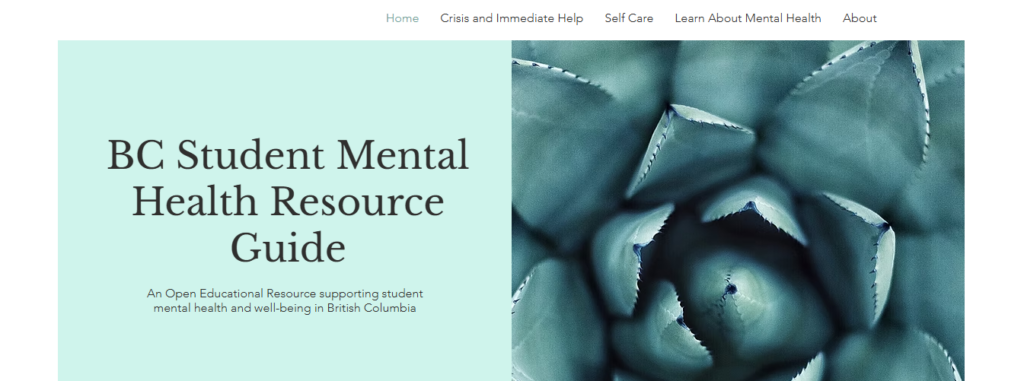
Preview of the home page made on Wix
Crisis and Immediate Help Page
If you or somebody you know is in crisis, please reach out right away
- Crisis lines:
- 988 Suicide Crisis Helpline. Available in English or French to call or text.
- 1-800-SUICIDE (1-800-784-2433) Crisis Intervention and Suicide Prevention Centre of BC. Available in up to 140 languages.
- 1-800-588-8717 BC KUU-US Indigenous Crisis and Support Line.
- 310-6789 (no area code) BC Crisis Line.
- These services are all confidential, free, and available 24/7.
In an emergency situation, please do not hesitate to visit your nearest emergency centre or call 911
Self Care Page
Everyday tips for self-care:
- Meditation
- Try this: Set a timer for 2 minutes, close your eyes and focus on your breathing.
- Journaling
- Try this: Take 5 minutes tonight to write down 3 things you are grateful for or things that went well today.
- Practicing mindfulness
- Exercise
- Spend time in nature
- Try this: Take a short walk on campus without headphones. What sounds, colours and smells do you notice?
- Connect with others
Free Online Resources/Apps:
Campus-Based Resources
Each post-secondary institution has its own mental health and wellness support. The examples below highlight a few key campuses. Check your own school’s student wellness or counselling page for specific programs and services.
University of Victoria
University of British Columbia
- AMS Peer Support
- UBC Student Recovery Community (SRC) for addiction recovery
- Counselling Services at UBC
Simon Fraser University
Douglas College
Camosun College
These are only a few examples of mental health support and resources offered at BC post-secondary institutions. Most campuses provide free or low-cost counselling, peer programs, and wellness workshops. Many also offer free online services for their students, making getting support more easily accessible. Check your school’s website for local resources.
Learn about Mental Health Page
What is Mental Health?
- Add information on what it is, why it matters, common mental health challenges in students, and signs that it might be time to reach out
About Page
About this resource
- Talk about the page and the motivation behind it
Open License
Content on the BC Student Mental Health Resource Guide is licensed under a Creative Commons Attribution 4.0 International License (CC BY 4.0). This means you are welcome to reuse, share, and adapt, and redistribute the material for any purpose, as long as credit is given to the creator.
This open license helps make mental health information and resources more accessible to students and encourages sharing and collaboration across British Columbia.
Download and Adapt
To support open sharing, editable versions of this resource are available below:
- List these
Anyone is welcome to download, modify, and redistribute these materials.
Principles Applied
To incorporate active learning and make the open educational resource more interactive, I added “try this” prompts under the everyday tips under the self-care page.
The personalization principle was used and is seen in the conversational, empathetic language that is used. I also used the signaling principle as I added headings and subheadings to each page to help keep the site organized and emphasize key information.